
Managing your portfolio · 1 of 2
Fund transfers in Spain: switch funds without paying tax
This article is about Spanish tax law, so it applies if you are resident in Spain for tax purposes. If you hold money in an investment fund and want to move it to another one, you do not need to sell and pay tax along the way. Spain has the traspaso, a fund-to-fund transfer: the money goes from one fund to the other and the tax office charges nothing until the day you really take it out. Here is how it works, what can be transferred and which mistakes to avoid.
7 min read
In short
- In Spain, moving money from one investment fund to another through a traspaso is not taxed: no gain is counted until you redeem and take the money out (article 94 of Ley 35/2006, the Spanish personal income tax law).
- Under Spanish tax law a fund transfer is a deferral, not an exemption: the new fund inherits the cost and purchase date of the old one.
- In Spain, Spanish funds and harmonised foreign funds registered with the CNMV can be transferred tax-free, while ETFs, as a general rule, cannot.
- In Spain the transfer is requested at the receiving institution; if you sell and buy again yourself, the tax office counts the gain even if you reinvest the same day.
What a fund transfer is
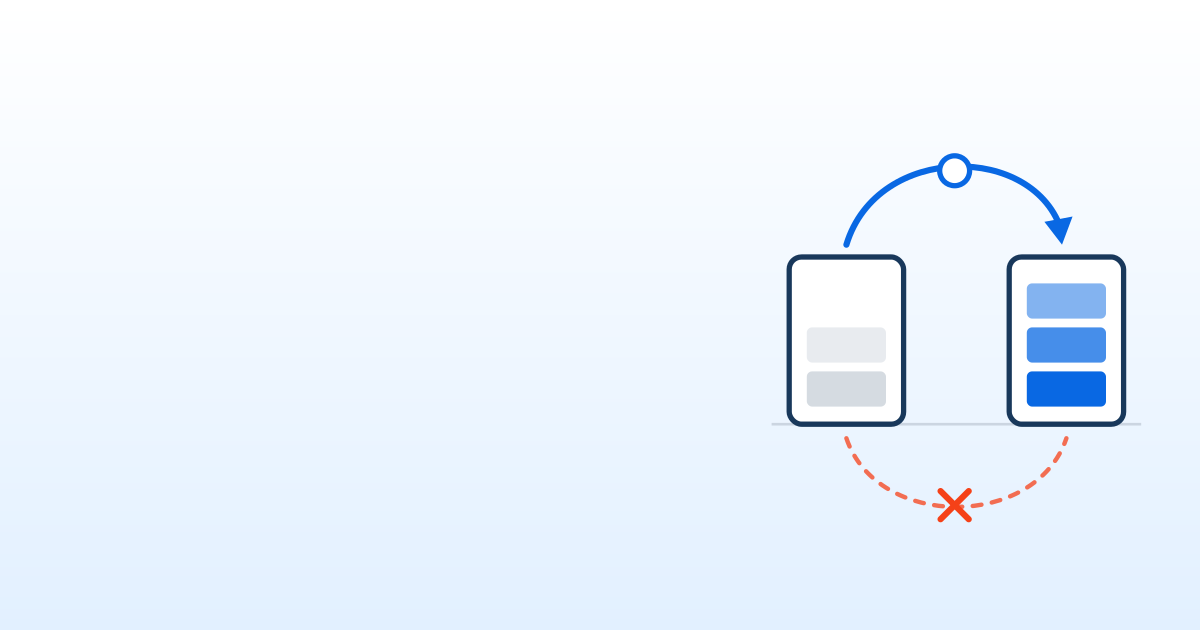
A transfer is an order to take your money out of one fund and put it straight into another, without it passing through your current account. Underneath there are two operations, a redemption in the source fund and a subscription in the target fund, but they are processed together and the money travels from fund to fund.
It is useful in many situations: switching to a cheaper fund, moving from equities to bonds as the time to use the money gets closer, or taking your funds to another bank or platform. In every case your tax bill stays on hold.
Why you pay no tax (yet)
The Spanish personal income tax law (Ley 35/2006, article 94) says that when the money from a redemption is used to subscribe another fund through the transfer procedure, no gain or loss is counted. The new units keep the acquisition value and date of the old ones.
An example. You put €10,000 into a fund in 2019 and today it is worth €14,000. If you sell, you have a €4,000 gain and, if you have no other savings income that year, you pay 19%: about €760. If you transfer it, the full €14,000 reaches the new fund and keeps working for you. For the tax office, though, that new fund cost you €10,000 in 2019.
That is why it is a deferral, not an exemption. The tax arrives on the day you redeem and take the money to your account, and the gain is then measured from your first purchase. The same goes for losses: a transfer does not let you book a loss to offset it in your tax return either.
What can and cannot be transferred
Yes: Spanish investment funds.
Yes, with conditions: foreign harmonised funds (UCITS) based in the European Union, as long as they are registered with the CNMV, the Spanish securities regulator, to be sold in Spain, and you buy and sell them through a distributor registered with the CNMV. If the fund is a company, like many Luxembourg funds that are SICAVs, each sub-fund must have more than 500 shareholders and you cannot have held more than 5% of its capital in the last 12 months.
Spanish SICAVs follow the same rule of 500 shareholders and 5%. If it is not met, selling their shares is taxed like any other sale.
No: ETFs, the funds listed on a stock exchange. Since 1 January 2022 the exclusion also covers foreign ETFs, wherever they are listed. There is only one exception: a foreign ETF bought before 2022 that is not listed on the Spanish stock exchange can move tax-free into a fund that is not listed. Shares and pension plans cannot be transferred into a fund either; pension plans have their own transfers between plans, with different rules.
How to order a transfer, step by step
Choose the target fund
Check that it can receive a transfer (a Spanish fund or a foreign one registered with the CNMV, never an ETF) and look at its fees before you decide.
Order it at the target entity
The order is given in writing to the fund manager or distributor where the money will arrive, not the one it leaves. If you have no account there, open one first. They take care of requesting the money from the old fund.
Decide whether it is full or partial
You can transfer everything or only part of it. In a partial transfer the units you bought first leave first (the FIFO rule), and each one takes its cost and date with it.
Allow a few days
The law sets the deadlines: the target entity notifies the source entity within one business day, the source entity has two business days to check it and then sends the money by bank transfer within the usual deadlines for a redemption. With foreign funds it can take a little longer.
Keep the confirmation
The transfer statement shows the acquisition value and date the new units inherit. You will need it on the day you really sell.
Mistakes that cost money
Selling and buying again. If you redeem the fund, the money reaches your account and then you buy another, it is no longer a transfer: the tax office counts the gain even if you reinvest it the same day. The law is clear: if the amount is made available to you in any way, there is no deferral.
Assuming everything can be transferred. An ETF looks like a fund, but for this purpose it is not one. Before moving the money, ask the target entity whether the operation will be done as a transfer.
Losing track of the cost. After two or three transfers, the fund you hold today carries the cost of purchases you made years ago in other funds. Some platforms show the amount that arrived with the transfer as contributed, and the gain you see does not match the one you will have to declare.
The idea to take away
If you are resident in Spain, investment funds let you change strategy, manager or bank without paying tax along the way: the transfer defers the bill until you take the money out and, meanwhile, that money stays invested. The condition is not to touch it: it must go from fund to fund, ordered at the target entity. If your case has nuances, check it with a tax adviser.
In MyPortfolio you can record each transfer exactly as it appears on your statement, in full or in part. The new fund inherits the cost and dates of the old one, so your real gain is neither inflated nor hidden, and you can see which part of the gain came with the transfer.
Frequently asked questions
Is a fund transfer taxed in Spain?
Not at the time of the transfer: under Spanish tax law, if the money goes from fund to fund through the transfer procedure, no gain or loss is counted. You pay tax when you redeem and take the money out, with the gain measured from your first purchase.
Which funds can be transferred tax-free in Spain?
Spanish investment funds, and harmonised foreign funds (UCITS) registered with the CNMV and bought through a distributor registered with it. If the fund is a company, like many SICAVs, each sub-fund needs more than 500 shareholders and you cannot have held more than 5% of its capital in the last 12 months.
Can I transfer an ETF into a fund without paying tax in Spain?
As a general rule, no: since 1 January 2022 ETFs, foreign ones included, are outside the Spanish fund transfer regime. The exception is a foreign ETF bought before 2022 that is not listed on the Spanish stock exchange, which can move tax-free into a non-listed fund.
How long does a fund transfer take in Spain?
A few days. Under Spanish rules the receiving institution notifies the original one within one business day, the original one has two business days to check it and then sends the money within the time of a normal redemption; with foreign funds it can take a little longer.
How does a partial fund transfer work in Spain?
You can transfer just part of a fund. Under Spanish rules the units you bought first leave first (FIFO), and each one carries its cost and purchase date to the new fund.