
Returns · 3 of 6
TWR vs simple return: why your real percentage may be different
If you have added or withdrawn money from your portfolio during the year, the return percentage you see at a glance can be misleading. The time-weighted return (TWR) fixes that: it measures how your investments performed, regardless of when or how much money you moved. Here is the difference, explained with a visual example.
5 min read
In short
- The simple return divides your gain by what you invested, and it is only reliable if you have not added or withdrawn money during the period.
- The time-weighted return (TWR) measures how your investments performed, regardless of when or how much money you added or withdrew.
- The TWR splits the period into sub-periods at every contribution or withdrawal, computes each sub-period's return and chains them together.
- The TWR is the standard for comparing portfolios and funds with each other and with a benchmark index.
What the simple return is
The simple return compares what your portfolio is worth today with what it was worth at the start: gain divided by the amount invested. It is easy to compute and good enough when no money goes in or out during the period.
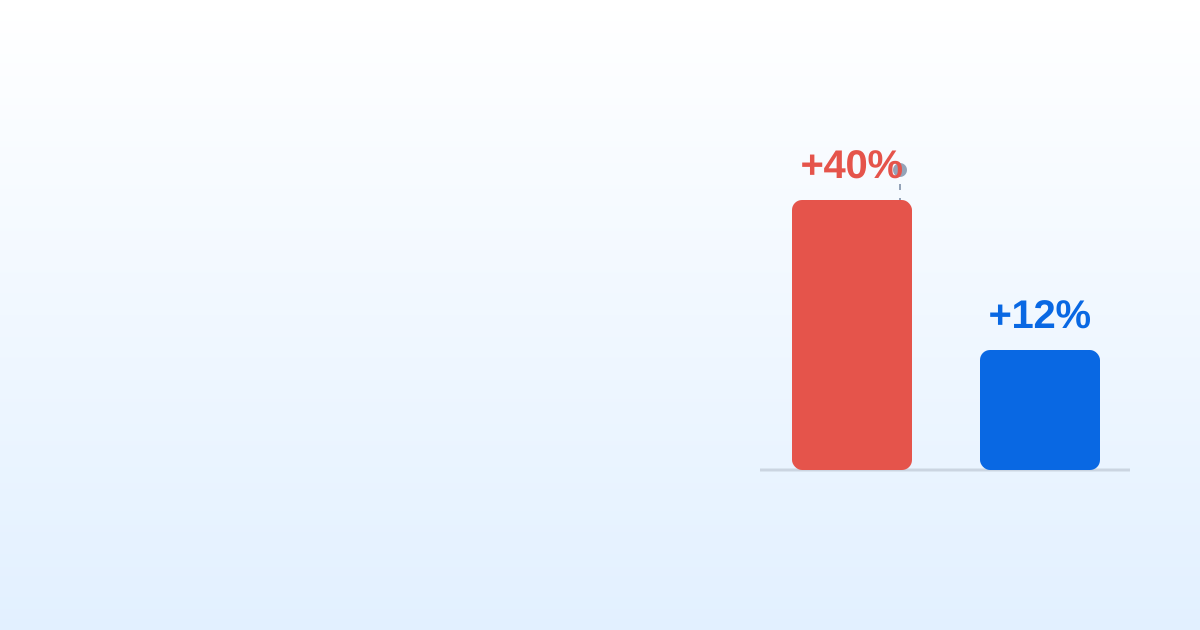
The problem shows up when you make contributions or withdrawals. Imagine you start the year with €10,000 and, right before a strong market run, you add another €10,000. Your portfolio grows a lot in euros, but much of that growth comes from adding more capital, not from your investments doing better. The simple return blends the two and hands you an inflated figure.
What TWR (time-weighted return) is
TWR measures how your investments performed while isolating the effect of your contributions and withdrawals. It answers the right question: how did my investments do, regardless of when and how much money I moved?
To do that, it splits the period into sub-periods every time cash enters or leaves, computes each sub-period's return separately, and then chains them together. A large contribution no longer contaminates the final number: only how the already-invested money behaved counts.
That is why TWR is the standard for comparing portfolios and funds against each other, and the metric benchmark indices use.
How it is calculated, step by step
Split the period into sub-periods
Every time you add or withdraw money, you close one sub-period and open another. A single contribution gives you two sub-periods: before and after.
Compute each sub-period's return
Within each sub-period, measure how much the money already invested grew, excluding the cash you just moved.
Chain the sub-periods together
Multiply the returns of all sub-periods. The result is the time-weighted return for the whole period.
The takeaway
If you never move money, the simple return and the TWR match. The moment you make contributions or withdrawals, the TWR is the honest figure for judging your investment decisions and benchmarking against an index.
MyPortfolio computes the TWR automatically, so you really know how your portfolio is doing without a recent deposit giving you a false sense of success.
Frequently asked questions
What is time-weighted return (TWR)?
It is a return measure that tracks how your investments performed while isolating the effect of your contributions and withdrawals. It answers how your investments did, regardless of when and how much money you moved.
How do you calculate the time-weighted return?
Split the period into sub-periods every time cash enters or leaves and compute the return of each one. Then chain them: multiply all the (1 + sub-period return) together and subtract 1.
When are the simple return and the TWR the same?
When you do not add or withdraw any money during the whole period. As soon as you make a contribution or a withdrawal, the two figures diverge.
Why is the simple return misleading when I add money?
Because it mixes how your investments did with the timing of your deposits. If you add money just before a good run, the figure comes out inflated even though your investments did no better.
What is the difference between TWR and MWR?
The TWR measures your strategy without counting when you added money; the MWR, or IRR, measures what your money earned, taking the date of each contribution into account. To compare yourself with an index, use the TWR.