
Risk · 1 of 3
How many ETFs should you own? Check the overlap first
There is no magic number of funds. A single global index fund can hold more than 2,400 companies in 47 countries, while ten funds can all repeat the same ones. What matters is overlap: how much of your money buys the same companies twice. Here is how to measure it with official MSCI and S&P data.
9 min read
In short
- More funds is not more diversification: what counts is how many different companies, countries and asset types sit inside them, not how many funds you hold.
- According to MSCI, on 30 September 2026 the US was 72.94% of the MSCI World, so pairing an MSCI World fund with an S&P 500 fund mostly buys the same US companies twice.
- A new fund only diversifies if it adds something you do not have yet: emerging markets, other regions, smaller companies or another asset class.
- To check, compare the country split and the ten largest holdings on your funds' factsheets, or look at the country breakdown of your whole portfolio.
Does owning more funds mean more diversification?
Diversifying means spreading your money across things that do not move together: companies, sectors, countries and asset types. The number of funds is just the vehicle. According to MSCI's factsheets as of 30 September 2026, a fund tracking the MSCI ACWI spreads your money across 2,414 companies in 23 developed and 24 emerging countries; one tracking the MSCI World, across 1,249 companies in 23 developed countries.
If you add a second fund that buys the same companies, you have two funds and exactly the same diversification as before. Only the weights change: what was already big gets bigger.
So the useful question is not how many funds to own, but what each one buys that the others do not.
What is fund overlap?
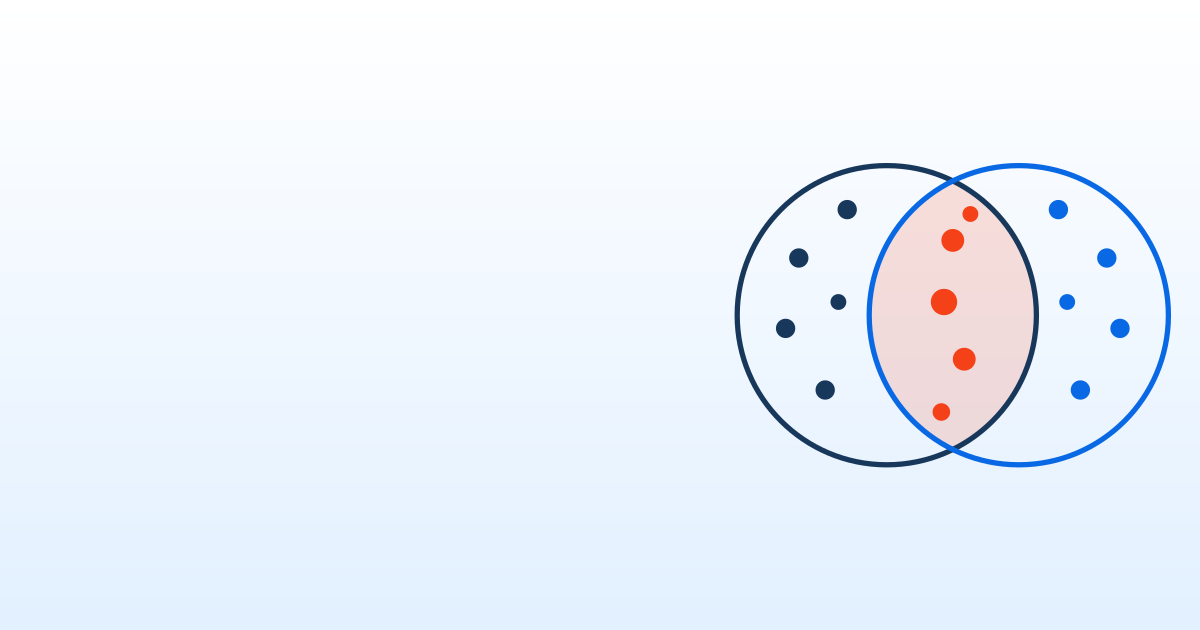
Overlap is the part of two funds' money that sits in the same companies. You work it out company by company: for every company both funds hold, take the smaller of its two weights, then add them all up.
A real example as of 30 September 2026: NVIDIA weighed 5.81% in the MSCI World and 8.4% in the S&P 500, where it is the largest holding. It adds 5.81 points to the overlap between the two indices, the part both have in common.
High overlap is not bad in itself. It means the second fund adds no new companies: it only changes how much each one weighs. If that is what you want, fine; if you wanted to diversify, it does not get you there.
MSCI World and S&P 500: how much do they overlap?
It is the most common pairing, and the data is clear. According to MSCI's factsheet as of 30 September 2026, the US made up 72.94% of the MSCI World. That US part is 513 companies (the MSCI World's 1,249 minus the 736 in the MSCI World ex USA), almost as many as the S&P 500's 503, and in both cases they are the large listed US companies.
The ten largest holdings are identical: NVIDIA, Apple, Microsoft, Amazon, Alphabet (with its two share classes), Meta, Broadcom, Micron and Tesla. They make up 27.85% of the MSCI World and 39.1% of the S&P 500, according to the MSCI and S&P Dow Jones Indices factsheets on the same date.
Put half in each and your US weight rises to 86.5% (half of 72.94% plus half of 100%), and 36.5% of your money buys US companies the other fund already holds. Try other combinations in the calculator.
| Index | Companies | US weight | Top 10 weight |
|---|---|---|---|
| MSCI World | 1,249 | 72.94% | 27.85% |
| S&P 500 | 503 | 100% | 39.1% |
| MSCI ACWI | 2,414 | 64.21% | 25.4% |
| MSCI World ex USA | 736 | 0% | 12.71% |
| MSCI Emerging Markets | 1,165 | 0% | 39.03% |
| MSCI Europe | 386 | 0% | 21.92% |
- US86.5%
- Europe7.6%
- Japan3%
- Other developed3%
- Emerging0%
How to complement a global fund without doubling up
A complement diversifies when it buys what your main fund does not. With MSCI indices this is easy to see because they fit together like pieces: the MSCI ACWI is the MSCI World plus the MSCI Emerging Markets, and their market caps on the factsheets add up exactly.
Emerging markets were 11.96% of the MSCI ACWI on 30 September 2026 (their market cap over the ACWI's). That is why 88% in an MSCI World fund and 12% in an MSCI Emerging Markets fund come very close to the ACWI's split, with no overlap between the two funds: they share no company at all. The MSCI Emerging Markets is led by Taiwan (28.94%), South Korea (21.4%), China (19.8%) and India (10.65%).
If your main fund tracks the S&P 500, the complement that barely crosses it is an MSCI World ex USA fund: 736 companies from the other 22 developed countries, led by Japan (21.84%), the United Kingdom (12.61%) and Canada (12.17%). Europe is 55.9% of that index.
What does not diversify: two ETFs tracking the same index from different providers, which overlap almost entirely, or a technology fund on top of an MSCI World, where technology is already 31.78% of the index and eight of the ten largest holdings are in technology or communication services.
How to check your funds' overlap, step by step
Write down the index each fund tracks
It is in the fund's name or in its key information document (KID). Two funds tracking the same index overlap almost 100%, even if they come from different providers.
Open each fund's monthly factsheet
The fund provider and the index provider publish the split by country and sector and the ten largest holdings every month. Always check the date: weights move with the market.
Compare countries and the top ten
If the same countries dominate and the same names head both lists, overlap is high. If one fund holds nothing from the other's main country, it is low.
Weight it by what you hold in each fund
Multiply each country's weight in each fund by the fund's weight in your portfolio and add them up. That gives your real exposure, the figure that matters: 50% in an MSCI World fund and 50% in an S&P 500 fund make 86.5% in the US.
Decide whether it is on purpose
High overlap can be a deliberate choice, such as giving the US more weight. What you want to avoid is having it without knowing.
How many funds or ETFs should you own? Rules of thumb and why
No single number suits everyone, but there are good reasons to decide by. This is not investment advice: they are questions to review your own portfolio with.
One can be enough for the equity part. A fund tracking the MSCI ACWI already covers 47 countries and 2,414 companies. Another global equity fund on top changes weights, not diversification.
Every new fund needs a job. Emerging markets, smaller companies, a region you want to give more weight, or bonds to lower the risk are jobs. “I liked this one too” is not.
If you already own half of a fund, think twice. It is a practical guide, not a law: when more than half of its weight is in regions and companies you already hold, what you buy is mostly more of the same.
Fewer funds, less work. Every fund is one more statement, one more set of fees to watch and one more weight to rebalance. One to three well-chosen funds cover the world's large and mid-sized companies; beyond that, each extra fund tends to repeat what you have.
How to see it in MyPortfolio
Doing these sums with several factsheets and a spreadsheet is slow, and the weights change every month. In MyPortfolio, the Distribution card in your portfolio's Summary splits your money by asset type, sector and country. By sector and by country, every fund and ETF is broken down by what it actually holds, so you see your real weight in the US and not just the names of your funds.
If a fund does not publish its breakdown, its share shows as “Unclassified” instead of being given a made-up country. You can load your transactions by importing your broker statement (CSV, Excel, PDF or a screenshot), and the app is free.
Frequently asked questions
How many ETFs should I own?
There is no right number: a single ETF tracking the MSCI ACWI already spreads your money across 2,414 companies in 47 countries. A second or third fund only adds diversification if it covers something the first does not, such as emerging markets, smaller companies or bonds.
Is it a bad idea to hold both an MSCI World and an S&P 500 fund?
It is not a mistake, but it diversifies little: on 30 September 2026 the US was 72.94% of the MSCI World, so a half-and-half split puts 86.5% of your money in the US. It is a bet on the US, and it should be a deliberate one.
How much of the MSCI World is the US?
According to MSCI's factsheet as of 30 September 2026, 72.94%. Next come Japan (5.91%), the United Kingdom (3.41%), Canada (3.29%) and France (2.24%).
Does the MSCI World include emerging markets?
No, it covers 23 developed countries. Emerging markets (24 countries, led by Taiwan, South Korea, China and India) are in the MSCI Emerging Markets and in the MSCI ACWI, which combines both.
How do I know if my funds overlap?
Look up the index each fund tracks, its country split and its ten largest holdings on the monthly factsheet: if they repeat, the funds overlap. In MyPortfolio, your portfolio's country breakdown already adds up what is inside each fund.